


Short answer: Pick the tube by how many ride at once: two, three or four. NSW, Victoria, SA and Tasmania cap towing at three people. Use a rope rated for your riders; the Jetpilot 1-4 Person Tube Rope suits every tube in the range. Add a bungee to smooth the pull and put every rider in a vest. Keep an observer watching every lap: every state and territory requires one.
Jump to
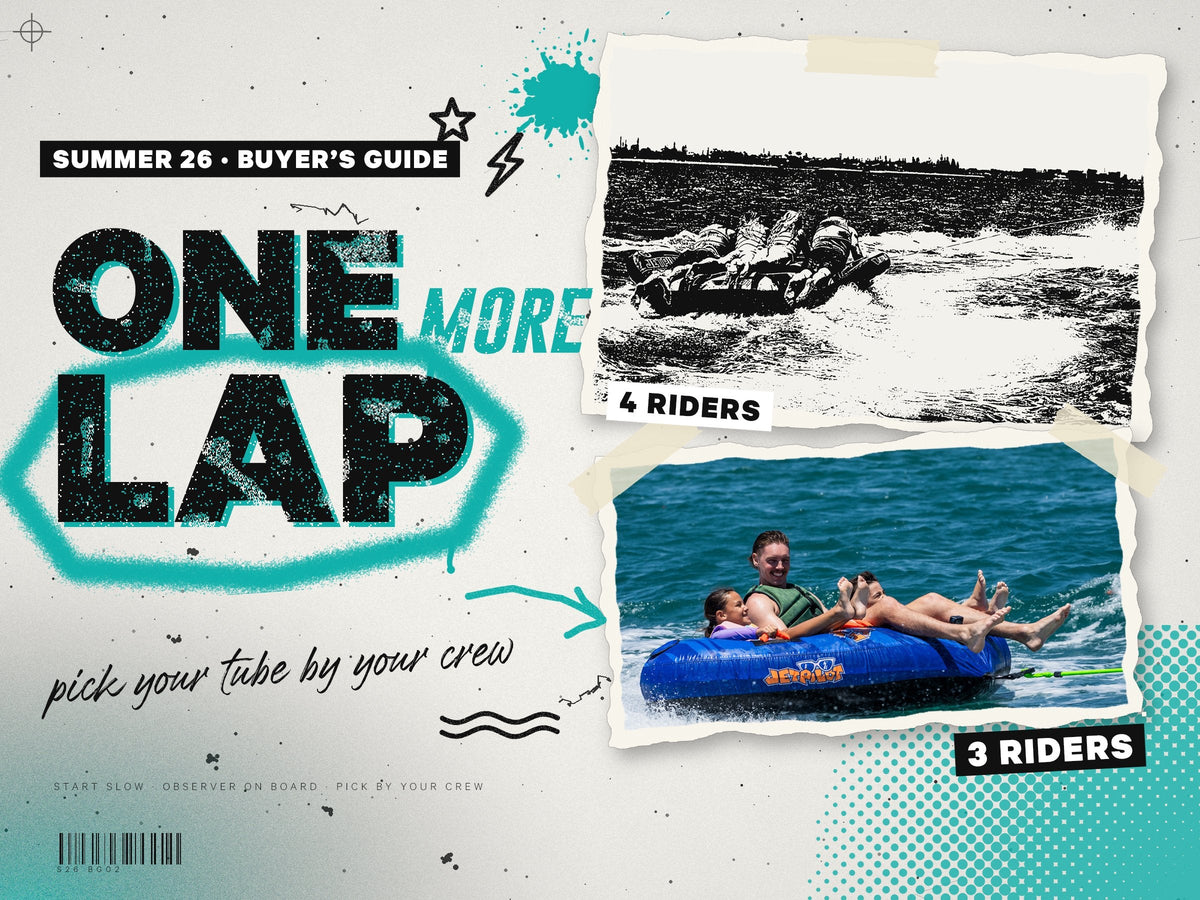
Every tube day ends the same way: somebody on the back yelling for one more lap. The tube decides how many of the crew ride at once and how those laps feel.
This guide sorts the range by crew size, then shows every tube up close: what it's built for, what it does well, and the questions to ask before you buy. After that come the rope, the pump and the towing rules, so the arvo runs sorted from the ramp to the last lap.
Jetpilot has been making gear for riders since 1986, and it's trusted by world champions in jet ski racing, wakeboarding and wakesurf. This summer it put eleven new tubes on the water, each with a double-stitched nylon cover, a self-bailing drain vent and a one-way Boston valve.
New for summer 2026
Eleven of the tubes in this guide are brand new this season: the Hyper Wing, Speedster, Whizzer, Chaser, Skater and Freeride. New shapes, thicker skins, same crew yelling for one more lap. We reckon it's the most fun tube line-up we've put on the water.
- Thicker skins: most of the new tubes run a 0.75 mm PVC bladder, up from 0.6 to 0.7 mm on last season's Skimmer and Slingshot.
- Double-stitched nylon covers on every new tube.
- New ways to ride: angled side wings on the Hyper Wing, body-grip deck fins on the Speedster, a skater ride base on the Skater, and neoprene ride pads and pull-up straps on the Freeride.
- More tube for your money: at full price, the Speedster 2, Whizzer 2 and Speedster 3 cost less than last season's Skimmer 2 and Skimmer 3, with a thicker bladder. The Hyper Wing 3 and 4 cost less than last season's Wing 3 and Wing 4.
Last season's Blast Off, Wing 2 and Wizzy Dizzy 2 are still in the range alongside the new models, so every crew size has a few shapes to choose from.
Which ski tube for your crew
Start with how many ride at once. Every Jetpilot tube is rated for a set number of riders, so stay within it. Then check your state: NSW, Victoria, SA and Tasmania cap towing at three people at once.
| Riders | Tubes |
|---|---|
| 2 |
Hyper Wing 2NEWSpeedster 2NEWWhizzer 2NEWChaser 2NEWSkater 2NEWBlast Off 2Wing 2Wizzy Dizzy 2 The most choice in the range.
|
| 3 |
Hyper Wing 3NEWSpeedster 3NEWWhizzer 3NEWFreeride 3NEWBlast Off 3 The most you can tow at once in NSW, VIC, SA and TAS.
|
| 4 |
Hyper Wing 4NEWFreeride 4NEWBlast Off 4 Crews of four, where your state allows it.
|
NEW marks the 11 tubes that are new for summer 2026.
Rider count is the first filter because it sets everything else: how big the tube is, how hard the rope works, and how many riders your observer has to watch. Buy for the crew you tow most weekends, then check the tube's rating before the extra cousin climbs on.

2, 3 or 4 riders: how to choose
The rider rating is printed on every Jetpilot tube, and it's the number to stay within. Here's what each size suits.
2-person tubes: the most choice
Two riders is where most crews start, and it's the biggest part of the range: eight tubes, from the Speedster 2 to the Wing 2. A two-up tube is smaller to pump and pack, and riders swap quickly between laps.
It's also a good size for kids and first-timers: one rider beside a parent or a mate, both within reach of the handles, and a driver who can keep the speed gentle. Pick by how you want it to ride: wings for a steadier ride, deck fins for grip, or a skater base for something different. The range below covers each one.
3-person tubes: the full load in four states
Three riders is the most NSW, Victoria, SA and Tasmania let you tow at once, so in those states a 3-person tube is the full load. Five tubes cover it: the Hyper Wing 3, Speedster 3, Whizzer 3, Freeride 3 and Blast Off 3.
A 3-person tube suits families who tow kids and parents in the same set, or a group of friends who'd rather ride than wait on the boat. Check the boat or ski can carry the driver, the observer and everyone waiting their turn before a third rider climbs on.
4-person tubes: room for the whole crew
Room for four: the Hyper Wing 4, Freeride 4 and Blast Off 4. NSW, Victoria, SA and Tasmania cap towing at three people at once, so in those states a 4-person tube carries three riders with room to move.
We found no cap in Queensland, WA or the NT, so check your state's rules before loading a fourth rider, and stay within the tube's rating. A bigger crew also means a bigger load on the rope: the 1-4 Person Tube Rope is made for towing up to four riders.
What goes into a Jetpilot tube
A tube looks simple: air, a cover and some handles. The difference between one that lasts a summer and one that lasts a few is in the details, and here's how Jetpilot builds them.
Performance: a shape for every crew
Jetpilot rates its tubes on its own speed-to-stability scale and says who each one is for. The Speedster sits at the fast end for thrill seekers, the Hyper Wing sits in the middle for the whole family, and the Blast Off sits at the stable end. For young children, Jetpilot points you to the Whizzer and the Blast Off.
Shape does the rest: raised side wings on the Hyper Wing, body-grip deck fins on the Speedster, the Chaser's chariot style, the Whizzer's inner-tube style, and a skater base on the Skater that tows forwards or backwards.
Comfort: padding where it counts
Every tube in the range has double-webbing foam handles with padded knuckle guards, which protect fingers when the tube whips wide. It's the part of the tube riders feel most, lap after lap.
Neoprene soft ride pads on the Hyper Wing and Freeride tubes put padding where you ride, the Wing 2 has a soft-touch ride surface, and pull-up straps on the Hyper Wing, Speedster, Freeride and Wing 2 make getting back on easier on tired arms.
Safety: built for the whole crew
Every Jetpilot tube carries a rider rating of 2, 3 or 4, and staying within it is the first safety rule. A reinforced tow system with a quick-connect hook gives you one proper tow point, so there's no reason to tie off to a handle.
Jetpilot's own towing advice is worth repeating. Start slow, because a rider on a whip is moving far faster than your speedometer shows. Always have an observer. And remember that it's the skipper's job to keep everyone on the water safe.
Innovation: new shapes and a patented camera mount
Eleven new tubes landed for summer 2026, and most carry Jetpilot's patented POV camera mount: a strong PVC mount with high-grade velcro that takes any POV camera. If you didn't film it, did it really happen?
The new tubes also add a one-way Boston valve and a self-bailing drain vent, so they clear water between runs and pack down quick at the ramp.
Built to last, and leave it as you found it
Every new tube runs a double-stitched 840D nylon cover with a PU3 durable backing and anti-fray technology for extra strength, over a 0.7 or 0.75 mm PVC bladder. Most tubes come with a puncture repair kit, so a small hole is a quick fix rather than the end of the tube.
Jetpilot's own sustainability line is gear designed to last, with the emphasis on quality, durability and a long life rather than fast fashion. Care is what makes a tube last more than one summer: rinse it, dry it, store it out of the sun, and patch small holes early. Jetpilot's own towing advice ends the same way: pack down, and leave your spot the way you found it, so the waterway stays clean for the next crew.
The range, up close
Every tube in the summer 2026 range, photographed in the studio from above so you can see the shape, the handles and where riders sit.
For each one, here's what it's for, how it's built, and the questions to ask before you buy. Jetpilot rates every tube on its own speed-to-stability scale and says who it's best for, and those ratings lead each card.
Hyper Wing 2, 3 and 4

The Hyper Wing is the family tube of the new range. Jetpilot places it in the middle of its speed-to-stability scale and says it's best for the whole family, and it comes in 2, 3 and 4-person sizes, so one shape can carry the kids on Saturday and the whole crew on Sunday.
Built-in angled side wings rise beside the neoprene soft ride pads, and pull-up straps make re-boarding easier after a fall. Under that, a heavy-duty 840D nylon cover with a PU3 backing wraps a 0.75 mm PVC bladder in the 3 and 4-person sizes (0.7 mm in the 2-person), with double-webbing foam handles, padded knuckle guards, a self-bailing drain vent, a one-way Boston valve and a POV camera mount.
Worried a bigger tube means a bigger bill? At full price, the Hyper Wing 3 and 4 cost less than last season's Wing 3 and Wing 4, and a puncture repair kit comes in the box. In NSW, Victoria, SA and Tasmania, the 4-person size still tows three at once: buy it for the room, not the headcount.
Speedster 2 and 3

The Speedster is the thrill-seeker's tube. Jetpilot puts it at the fast end of its speed-to-stability scale, and it's the new entry point to the range, in 2 and 3-person sizes.
Body-grip deck fins at the back corners give riders something to dig into, and pull-up straps help them back on. It runs a 0.75 mm, 30-gauge PVC bladder under a double-stitched 840D nylon cover with a PU3 backing, plus double-webbing foam handles with padded knuckle guards, a self-bailing drain vent, a one-way Boston valve and a POV camera mount.
Worried the lowest-priced tube in the range is the flimsy one? At full price, the Speedster 2 and 3 cost less than last season's Skimmer 2 and 3, yet they carry a thicker 0.75 mm bladder and the same 840D cover as the rest of the new range, with a puncture repair kit in the box. Inflate to 1 psi, and start slow: on a whip, a rider moves far faster than your speedometer shows.
Whizzer 2 and 3

The Whizzer is the sit-in tube for young children. Jetpilot calls it inner-tube style: riders sit down into their own seat, two side by side in the Whizzer 2 and three in a row in the Whizzer 3, which suits kids who'd rather sit than lie on a deck.
It has a double-stitched 840D nylon cover with a PU3 backing, double-webbing foam handles with padded knuckle guards, a reinforced tow system with a quick-connect hook, a self-bailing drain vent and a one-way Boston valve. The Whizzer 3 adds a POV camera mount, and both come with a puncture repair kit.
Fast enough for older kids? Jetpilot rates it mid-scale for speed versus stability, a step up from the Blast Off without being a thrill ride. Ride to the youngest rider on board, and check the rider rating before anyone squeezes in.
Chaser 2

The Chaser 2 is the cruiser. Jetpilot calls it chariot style and places it toward the stable end of its scale, best for cruising: a two-rider tube for crews who want a relaxed lap more than a wild one.
It runs a 0.7 mm, 28-gauge PVC bladder under a double-stitched 840D nylon cover with a PU3 backing, with double-webbing foam handles and padded knuckle guards, a reinforced tow system with a quick-connect hook, a self-bailing drain vent and a one-way Boston valve. A puncture repair kit comes in the box, and Jetpilot recommends inflating it to 1 psi.
Two riders only, so it suits smaller crews, a parent riding with a child, or anyone who'd rather sit back and enjoy the ride. Want the same calm ride for more people? Look at the Freeride 3 or 4.
Skater 2

The Skater 2 is the different one. Its skater ride base sits inside a raised rim, and it's the only tube in the range with a dual-direction quick-connect tow hook, so you can tow it forwards or backwards. Jetpilot's line for it is "less drag, more fun".
Underneath, it's the full new-season build: a 0.75 mm, 30-gauge PVC bladder, a double-stitched 840D nylon cover with a PU3 backing, double-webbing foam handles with padded knuckle guards, a self-bailing drain vent, a one-way Boston valve, a POV camera mount and a puncture repair kit.
Jetpilot rates it best for cruising, and it carries two riders. It suits crews who've done the standard laps and want a new way to ride the same water.
Freeride 3 and 4

The Freeride tubes are the cruisers for bigger crews, in 3 and 4-person sizes. Jetpilot rates them best for cruising, toward the stable end of its scale, with neoprene soft ride pads to sit on and pull-up straps for getting back aboard.
Both run a 0.75 mm PVC bladder under a double-stitched 840D nylon cover with a PU3 backing, with double-webbing foam handles and padded knuckle guards, a self-bailing drain vent, a one-way Boston valve, a POV camera mount and a puncture repair kit.
The Freeride 3 and 4 held their full price from last season. In NSW, Victoria, SA and Tasmania the Freeride 4 tows three at once, which makes it the roomy option for a full legal load.
Blast Off 2, 3 and 4

The Blast Off is the ride-on rocket: riders sit astride in a row, two, three or four of them. Jetpilot puts it at the stable end of its scale and says it's best for young children.
It has a 0.65 mm PVC bladder inside a nylon cover with a zipper, double-webbing foam handles with padded knuckle guards, a reinforced tow system, a quick-connect hook and a puncture repair kit. Jetpilot recommends inflating it to 1 psi.
Why pick it over the new tubes? The rocket shape and the stable rating suit first-timers and young kids who want to sit up and see where they're going. Like any tube it can tip on a hard turn, so ease off into corners. The new tubes add thicker bladders and drain vents, which makes them the pick for crews who ride hard.
Wing 2

The Wing 2 is the last of last season's Wing line: a two-rider tube with built-in angled side wings, which Jetpilot says are there for added stability, and a soft-touch ride surface.
It has a full 840D nylon cover with a zipper, a heavy-gauge PVC bladder, pull-up straps for re-boarding, double-webbing foam handles with padded knuckle guards, a reinforced tow system with a quick-connect hook, a POV camera mount and a puncture repair kit. Its ideal inflation is 0.8 to 1.0 psi.
Like the Wing's shape but need room for more riders? The Hyper Wing carries angled side wings into 3 and 4-person sizes, and adds a self-bailing drain vent and a one-way Boston valve.
Wizzy Dizzy 2

The Wizzy Dizzy 2 is the spinner of the range: a two-seat tube with sit-in seats side by side, made for riders who want the ride to spin.
It has a full nylon cover with a zipper, a heavy-gauge PVC bladder, double-webbing foam handles with padded knuckle guards, a reinforced tow system with a quick-connect hook and a POV camera mount.
It's a ride for confident riders rather than first-timers, so keep the speed in check and let the riders call it with hand signals.
What to look for in a ski tube
Start with the skin. The PVC bladder holds the air, and a thicker one is tougher. Most of the new tubes run a 0.75 mm bladder and the rest 0.7 mm, while the Blast Off tubes run 0.65 mm. Over the bladder, a nylon cover takes the wear: every new tube has a double-stitched 840D nylon cover with a PU3 durable backing, which Jetpilot builds with anti-fray technology for extra strength.
Then look at where hands and bodies go. Every tube in the range has double-webbing foam handles with padded knuckle guards, which protect fingers when the tube whips wide. Neoprene soft ride pads on the Hyper Wing and Freeride tubes put padding where you ride, the Speedster's body-grip deck fins give riders something to grip, and pull-up straps on the Hyper Wing, Speedster, Freeride and Wing 2 make it easier to climb back on after a fall.
Finally, the hardware. Every tube has a reinforced tow system with a quick-connect tow hook, so hooking up is quick. The new tubes add a one-way Boston valve and a self-bailing drain vent, so they clear water between runs and pack down quick at the ramp. Most of the range also carries a POV camera mount, and most tubes come with a puncture repair kit in the box.
Shape changes the ride: angled side wings on the Wing 2 and Hyper Wing, body-grip deck fins on the Speedster, a skater ride base on the Skater, and a tube made for spinning in the Wizzy Dizzy 2. Pick the shape for the crew, then check the rider rating.

Rope, bungee, pump and bag: the rest of the kit
The tube gets the photos. The rope does the work. Match the rope to the riders on board, add a bungee to smooth out the strain of towing, and bring a pump that suits how you travel.
One rope and one bungee suit every tube in the range, so you can buy them once and keep them as the crew grows.
1-4 Person Tube Rope

The 1-4 Person Tube Rope is the one rope for the whole range: 60 ft (about 18.3 m) of 2-strand PE rope with a 1,882 kg breaking strain, designed for towing up to four riders behind a boat or a jet ski.
The rope does the hardest work of the day, so check it before every set: look for fraying, flat spots and worn ends, and replace it if you find them. One rope rated for four riders covers you whichever tube goes on.
Towable Bungee Cord 4 Ft

The Towable Bungee Cord adds 4 ft of 9/16 elastic bungee to the tow line to smooth out the strains and stress of towing. It's rated at 1,882 kg and made for all 1 to 4 person towables.
It's optional, but on a family day it's an easy upgrade. Jetpilot's packaging puts it simply: smoother towing that reduces strain on tubes and riders.
Ski Tube Hand Pump and Electric Air Pump

The Ski Tube Hand Pump is a double-action push-pull pump that moves air on both the up and down stroke, and it inflates as well as deflates. It has a large non-kink hose with interchangeable nozzles, a locking system that keeps the hose on the pump, and a large handle and foot plate.
The Electric Air Pump for Inflatables is a DC pump that inflates and deflates large inflatables, runs to 1.45 psi and comes with five valves. Most tubes want about 1 psi, so stop when the tube is firm rather than running it flat out.
Ski Tube Carry Bag

The Ski Tube Carry Bag fits every Jetpilot towable. It's extra-heavy-duty nylon with an oversize zip, three cinch straps with buckles to pull it tight around the tube, and shoulder straps for the bigger tubes.
A tube packed dry in its bag stays out of the sun between trips, which is what keeps it going for more than one summer, and the shoulder straps make the walk from the car to the ramp a lot easier.
Hooking up
Connect the rope to the tube's tow point, never a grab handle. Attach the other end to a point built for towing: a ski pylon, transom tow eyes or a tow harness on a boat, or the tow point at the back of a jet ski. Check both ends before every set.
In NSW, the person being towed must be at least 7 m behind the boat. A 60 ft rope puts the tube about 18 m back, and that extra room helps on every turn.
Pumping it up
Pump the tube until it's firm, not drum-tight. Air expands in the heat, so let a little out if the tube sits on a hot deck or beach.
Most Jetpilot tube pages give a target of 1 psi, and the Wing 2 sits at 0.8 to 1.0 psi, so check the page for yours. The Electric Air Pump for Inflatables runs to 1.45 psi, which is more than most tubes want, so stop when the tube is firm rather than running the pump flat out.
Towing rules and safe laps
We checked these points against each state's official rules in October 2026. Rules change, so check yours before you ride.
- Observer, every lap: in every state and territory, someone other than the driver must watch the person being towed, on a jet ski too. Minimum observer ages run from 12 to 16, depending on the state.
- Towing with a jet ski: your observer rides with you, so the ski must be rated for at least two people.

- A vest on every rider: tube riders must wear a life jacket in every state and territory except WA, where it's recommended. A Level 50 or 50S vest meets the rule wherever a level is set. SA and Tasmania don't allow inflatable life jackets for towed riders. Find yours in the life jacket buyer's guide.
- Three at once in four states: NSW, Victoria, SA and Tasmania cap towing at three people at once.
- Daylight only: no towing between sunset and sunrise in NSW, SA or Tasmania. In Victoria, no towing from an hour after sunset to an hour before sunrise. In WA, check the gazetted ski areas and their set times.
- Ride to the youngest rider: slow down for kids and first-timers. Agree on hand signals before you start: thumbs up for faster, thumbs down for slower, a hand across the throat to stop.
- Give it room: stay well clear of swimmers, moorings, the shore and other boats. The tube swings wide on every turn.
The observer's job is simple: watch the tube, call falls and hand signals to the driver, and never take their eyes off the riders. Brief them before the first lap, and swap them out before they lose focus.
Rules change, and some apply only on certain waters, so treat this list as the short version and check your state's maritime authority before you head out. More detail for two states: NSW and Queensland towing rules.

Looking after your tube
Rinse the tube, rope and bungee in fresh water after a salty session. Let everything dry, then deflate the tube and pack it away out of the sun.
Before the first lap of the season, check the seams, handles, tow point and valve. Most Jetpilot tubes come with a puncture repair kit, so a small hole caught early is a quick fix rather than the end of the tube's summer.
The Ski Tube Carry Bag fits every Jetpilot towable and has shoulder straps for the bigger tubes. It makes the walk from the car to the ramp easier and keeps the tube out of the sun between trips.
FAQs
How many people can you tow on a tube?
No more than the tube is rated for, and no more than your state allows. NSW, Victoria, SA and Tasmania cap towing at three people at once.
Every Jetpilot tube carries a rider rating of 2, 3 or 4. We found no cap in Queensland, WA or the NT, so check your state's rules and stay within the tube's rating.
Can I use a 4-person tube in NSW?
Yes, with up to three riders on it. NSW caps towing at three people at once, and so do Victoria, SA and Tasmania.
A 4-person tube still earns its place there: three riders get more room to move, and it's ready for a fourth rider in a state without a cap.
How long should a tube rope be?
The Jetpilot 1-4 Person Tube Rope is 60 ft, about 18 m, and made for towing up to four riders.
NSW also sets a minimum: the person being towed must be at least 7 m behind the boat, so a 60 ft rope clears it with room to spare.
Can you tow a tube behind a jet ski?
Yes. Every state and territory requires an observer watching the person being towed, and on a jet ski the observer rides with you, so the ski must be rated for at least two people.
Tow from the ski's tow point with a rope rated for your riders, and keep the speed gentle, because the tube swings wide on every turn.
Do tube riders need to wear life jackets?
Yes, in every state and territory except WA, where it's recommended. A Level 50 or 50S vest meets the rule wherever a level is set.
SA and Tasmania don't allow inflatable life jackets for towed riders, so put every rider in a foam vest.
How fast should you tow a tube?
Slower than you think, especially with kids on board. Ride to the youngest or least confident rider, and ease off into turns.
Let the riders set the pace with hand signals agreed before you start: thumbs up for faster, thumbs down for slower, a hand across the throat to stop.
Does the observer need a boat licence?
Not in most cases. The rules set a minimum age for the observer instead, from 12 in Victoria and 13 in Queensland to 14 in WA and Tasmania and 16 in NSW and SA.
Younger observers need extra paperwork in some states: in NSW an observer under 16 must hold a boat or PWC licence, in SA 12 to 15-year-olds need a special permit and a skipper aged 18 or over, and in Tasmania an under-14 needs a provisional licence.
Do I need a bungee for my tube rope?
It's optional. The 4 ft Towable Bungee Cord adds elastic to the tow line to smooth out the strain of towing.
It's rated at 1,882 kg and suits all 1 to 4 person towables, so one bungee covers every tube in the range.
Tube season in 30 seconds
Find your tube
Count the crew, grab the rope, pump it up. One more lap starts here.
Every tube in this guide sits in the tube collections, sorted by crew size, with the rope, bungee and pumps one click away. Stuck between two sizes? Buy for the crew you tow most weekends, and check your state's cap before the extra rider climbs on.
Shop ski tubes · 2-person · 3-person · 4-person · Ropes and bungees