


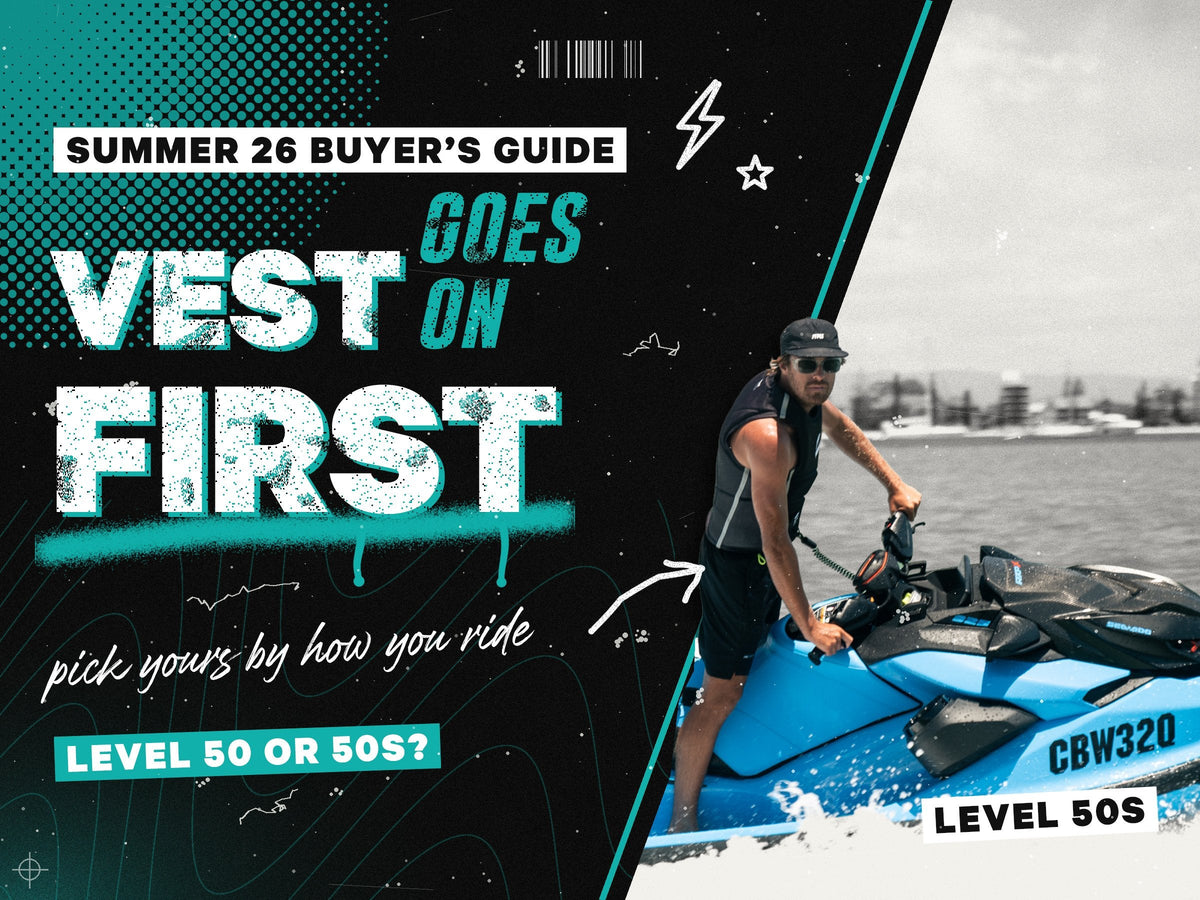
Short answer: On smooth water (rivers, lakes, bays), a Level 50S vest is accepted on a jet ski in every state, and NSW, Victoria, SA and WA accept it on all waters. Riding beyond smooth water in Queensland? You'll need Level 50: the same float in high-vis. Pick the vest by how you ride, size it by your chest, and check your state.
Jump to
Every summer starts the same way at the ramp: someone grabs a vest out of the shed, zips it over a T-shirt, and hopes it's the right one. Most of the time it's fine. Some of the time it's the wrong level for the water, two sizes too big, or still on the passenger seat.
This guide sorts that out. Find how you ride, match it to a vest in the Summer 2026 range, check the level against your water, and run the 60-second fit check before the first sesh. Every vest is shown up close, with what it's built for and the questions riders ask before they buy.
Jetpilot has been making gear for riders since 1986, and it's trusted by world champions in jet ski racing, wakeboarding and wakesurf. Every vest in this guide is foam and approved to Australian Standard AS 4758, so it floats the moment you hit the water, with nothing to pull and nothing to service.
Which Jetpilot vest for how you ride
Start here. The level tag is the one that matters for the law; the vest is the one that matters for comfort.
| How you ride | Vests |
|---|---|
|
Weekend laps and cruising 50S
|
Cause360 VentureRetro |
|
Beyond smooth water 50 high-vis
|
40 Year Nighthawk RedVenture Plus Red or YellowCause Red, Yellow or OrangeTitan Nylon |
|
Fishing and long days
50S50 high-vis
|
Venture Plus360 Venture |
|
Race day
50S50 high-vis
|
Vault Hyperflex |
|
Behind the boat 50S
|
FreeridePhase Hyperflex |
|
For her
50S50 high-vis
|
Cause LadiesEden |
|
Kids and infants Mostly 50S
|
Cause KidsFreeride Boys and GirlsPaddle Pal SplashCause Infant |
Every vest in the table is shown up close further down, with what it's for and how it fits. If you ride more than one way, start with the water you ride most, then check the level against your state.

Level 50S vs Level 50: what the label actually means
Every vest in this guide is approved to Australian Standard AS 4758. The number on the label is the level, and on a jet ski you'll only ever need one of two.
Level 50S: the ski, wake and tow vest
Level 50 Special Purpose. It comes in any colour, and it's the level most riders wear on the ski, behind the boat and on the tube. On smooth and enclosed water (rivers, lakes, dams and sheltered bays) it's accepted on a jet ski in every state.
NSW, Victoria, SA and WA go further and accept a Level 50S on a jet ski on every water a ski may use. For most riders in those states, it's the only level they'll ever need.
Level 50: the same float in high-vis
Level 50 has the same buoyancy rating as 50S. The difference is visibility: it comes in high-vis colours so you're easier to spot in the chop.
Jetpilot makes Level 50 colourways for riders who take the ski beyond smooth water where their state asks for it. Queensland, for one, requires Level 50 on a jet ski in partially smooth and open water, and a 50S only covers smooth water there.
Why there's no Level 100 in this guide
Level 100 and above are jackets built for open water. Queensland and South Australia only list Level 50 and 50S for a jet ski. The exception is Tasmania: beyond sheltered water, generally more than 2 nautical miles from land, a jet ski rider needs a foam Level 100 or higher. None of the vests in this guide covers that, so plan accordingly if you ride that far out.
Rules change by state and by water, so treat this as the short version and check your state's rules before you ride. The full Level 50 vs 50S guide goes deeper.

What goes into a Jetpilot vest
Every Jetpilot vest starts with the same brief: float you, fit you, and stay comfortable from launch to retrieval. Here's what that looks like across the range.
Performance: built with the people who ride hardest
Jetpilot has been making gear for riders since 1986, and it's trusted by world champions in jet ski racing, wakeboarding and wakesurf. The Vault line is the race gear those riders compete in, and its signature wake riders help shape the fits and materials in the wake range.
That shows up in the fits. Each vest is cut for a job, from the ultra-tapered 40 Year Nighthawk to the trimmed straight fit of the Venture Plus and the relaxed multi-fit of the 360 Venture.
Comfort: worn all day, from launch to retrieve
Most of the range has an Ecoprene shell, which Jetpilot describes as lightweight, ultra-soft and tough where it counts, and rates 30% lighter than traditional neoprene. Freelite bevelled-edge foam keeps the profile low and the flex high, so the float works with your body rather than boxing it in.
The 360 Venture goes further, with a Hyperflex panel under the chest and a back flex gusset at the base of the spine. Together they let one vest expand, flex and bend to fit a range of body types, which helps when you're between sizes or sharing a vest across the crew.
Safety: the standard, plus the hardware
Every vest in this guide is approved to AS 4758 at Level 50S or Level 50, and the level is stated for each colour, so you can buy to your state's rules.
Then come the details. Jetpilot's patented Supergrip handles are on most of the range, hidden on the Cause and Cause Ladies, so a passenger always has something solid to hold. There's reflective taping on the Venture vests and the Titan, lanyard safety clips throughout, and room for an ACR or PLB on the Venture vests for riders heading offshore.
Innovation: patents, pockets and a Good Design Award
Jetpilot's Pro-Tech race protection won a 2025 Good Design Award for innovation in safety and design of wetsuits and life jackets for watercraft riders. Jetpilot introduced its patented Supergrip handles in 2012 and Ecoprene in 2022.
The Venture Plus shows where that leads: a built-in IPX8 waterproof Fidlock pocket that seals itself magnetically, a POV camera mount, rear stash pockets, and a fit for Jetpilot's Venture hydration bladder and fishing gimbal.
Built to last, and sustainability
Vests get thrown in boat lockers, left on hot decks and dragged up ramps. The range is built for that, with durable PK Lok and YKK zips, Ecoprene shells that are tough where they count, and graphics sublimated into the fabric so they don't peel. The Titan goes further, with a heavy-duty 600D shell built for rental fleets.
On sustainability, Jetpilot's own line is gear designed to last, with the emphasis on quality, durability and a long life rather than fast fashion. The outer shell of its Ecoprene vests is made from recycled plastic bottles, and the longest-lasting vest is the one that's looked after. Rinse it in fresh water, dry it in the shade, and check the zips and buckles before each season.
The range, up close
Every vest in this guide, photographed in the studio so you can see the details: the zips, the buckles, the handles and the pockets.
For each one, here's what it's built for, how it's made, and the questions riders ask before they buy. The tags show the riding style it suits and the level for each colour.
Cause: the all-rounder

The Cause is Jetpilot's original life jacket and its longest-running series, first designed for PWC recreation and now worn across every watersport. Jetpilot says it has refined the Cause for over 20 years, and it's the vest to start with for weekend laps, runs to the sandbank and boat days.
Patented hidden Supergrip handles give a passenger something solid to hold without cluttering your ride, and a lanyard safety clip keeps the kill switch on you. A durable PK Lok zip and Freelite buoyancy foam finish the build. Black, Blue and Grey are Level 50S in Ecoprene; the high-vis Red, Yellow, Orange and Charcoal/Orange are Level 50.
Which colour for your water? A 50S colour covers smooth water everywhere and all waters in NSW, Victoria, SA and WA; pick a high-vis Level 50 if you ride beyond smooth water in Queensland. Sizes run S to 4XL, and the fit should feel tight when dry: it gives a little once it's wet.
360 Venture: one vest, many fits

The 360 Venture is the touring vest with dual sizing: S/M, L/XL, 2XL/3XL and 4XL. A Hyperflex expansion panel under the chest and a back gusset let it expand, flex and bend to fit a range of body types, which helps when you're between sizes or sharing a vest with your partner.
It's built for days that need gear: a radio webbing chest mount with an aerial holder, two front bellows pockets with D-links, a back stash mesh pocket, a POV camera mount, shoulder reflective tape and dual front lanyard safety clips. It's ready for an ACR or Ocean Signal PLB, with Supergrip handles for a passenger.
Black and Blue are Level 50S; Orange and Red are Level 50 for riders beyond smooth water where their state asks for it. With an anatomical unisex fit and dual sizing, it's also the easiest vest to buy as a gift when you can only guess the size.
Retro: the heritage side-entry

The Retro is a nod to Jetpilot's early days: a three-buckle side-entry vest in Retro Yellow, with retro branding and a custom heat-transfer panel for your race name and number. It's for retro ski days, PWC cruising and anyone who likes to stand out on the water.
Under the throwback look is current gear: Australian Standards nylon fabric, Freelite buoyancy foam, three buckles you adjust for a locked-in fit, and a lanyard safety clip. Sizes run XS to 2XL.
It's bright yellow, but it's Level 50S, so on a jet ski it's a smooth-water vest. If your state wants Level 50 for your water, look at the high-vis Level 50 colours of the Cause or the 40 Year Nighthawk.
40 Year Nighthawk: the anniversary edition

The 40 Year Nighthawk marks four decades of Jetpilot: a limited-edition side-entry vest wrapped in an exclusive heritage print, made for jet ski and wake riders alike. Black is Level 50S; the Red is high-vis Level 50.
Side entry means no zip and buckle stack across the chest, so the vest sits slimmer, hugs the torso and leaves your shoulders and core free when you're reaching for the handlebar or the rope. It has an Ecoprene shell, a durable YKK Lok zip, Freelite bevelled-edge foam and an anatomical fit, in an ultra-tapered cut.
Side entry fits differently from a front zip, so try it on with the buckles done up and run the lift test. Sizes run S to 2XL, and as a limited edition, it won't be in the range forever.
Titan: heavy-duty high-vis

The Titan is the heavy-duty one, built for rental companies and anyone who's hard on gear. It's high-vis Level 50, with a tough 600D outer shell and a three-buckle front entry that's quick to get right on every rider.
Supergrip handles give a passenger a solid hold, reflective taping helps at dawn and dusk, and a lanyard safety clip keeps the kill switch on you. There's space on the front and back for custom screenprinting, for hire fleets that want their name on it.
Its multi-fit sizing runs S/M, L/XL, 2XL and 3XL. For a rental fleet, or a family boat that sees every shape of rider, the Titan is the practical pick.
Venture Plus: the all-day fishing vest

Venture Plus is built for boaters and fishos who keep the vest on from launch to retrieve. Jetpilot designed it for PWC adventures, fishing and full-day excursions, and it carries the gear those days need.
The headline is the built-in Fidlock waterproof pocket, rated IPX8, which seals itself magnetically around your phone and keys. Add a quick-access pocket, a back stash mesh pocket, a hydration pack pocket, D-rings and webbing loops, a POV camera mount, shoulder reflective tape and patented Supergrip handles. It also works with Jetpilot's fishing gimbal and an ACR or Ocean Signal PLB.
Black is Level 50S; Red and Yellow are Level 50 for riders heading beyond smooth water. Need room for a radio? The 360 Venture adds a radio chest mount and dual sizing.

Vault Hyperflex: race-bred

Vault is Jetpilot's race and performance line, trusted by pro athletes and world champion riders, and the Vault Hyperflex is the vest built for PWC racing and high-performance riding.
A Hyperflex expansion panel wraps the midsection so the vest moves with you, and its contoured fit and segmentation cut the bulk, not the performance. Supergrip handles, a durable PK Lok zip and bevelled-edge buoyancy foam round it out.
It's a close, anatomical fit, and some riders find it snug, so size by your chest measurement rather than your T-shirt size, and if you're between sizes, try the larger. Check your series' rulebook as well as your state.
Freeride: the wakeboard vest

The Freeride is Jetpilot's wakeboard vest, made for wakeboarding and wakesurfing, with a clean look and minimal screenprinted branding. Jetpilot rates it for recreational wake, in a relaxed fit.
Its Ecoprene shell, which Jetpilot rates 30% lighter than traditional neoprene, is made from recycled plastic bottles, and it pairs with Freelite buoyancy foam, an anatomical fit and a durable PK Lok zip. The bevelled foam contours to your body, so it stays snug without restricting carves, spins and long days behind the boat.
All four colours, Black, Blue, Sage and Steel Blue, are Level 50S. Sizes run S to 3XL, and it should feel tight when dry: it gives a little once it's wet.
Phase Hyperflex: nothing in the way

The Phase Hyperflex is the crossover vest for riders who split their time between the ski and the wake, built for wakeboarders and wake surfers with Jetpilot's Hyperflex expansion panel across the midsection.
The panel gives unrestricted stretch through spins, grabs and carves, and the anatomical fit and durable PK Lok zip keep it locked in, session after session. It has an Ecoprene shell and Freelite buoyancy foam.
Black, Green and Red are all Level 50S, in sizes S to 4XL. It runs close, so measure your chest and check the chart before you order.
Cause Ladies: the all-rounder, cut for her

Cause Ladies is the women's version of Jetpilot's longest-running vest, cut for her rather than a men's vest in a smaller size, for PWC and boat days, tubing and skiing. The updated fit brings more inclusive sizing, from 6 to 18.
Patented hidden Super Grip handles, a durable PK Lok zip, Freelite bevelled-edge foam and a D-link clip for the lanyard carry over from the Cause. The new summer 2026 Multi is Level 50S, alongside Black, Char/Black and Pink/Charcoal; the Red and Yellow colourways are high-vis Level 50.
Fit varies more between bodies than size labels suggest, so measure your bust and check the chart on the product page rather than going by your dress size.
Eden: the performance PWC vest for her

Eden is the women's performance PWC vest: Jetpilot's pro wake fit, re-imagined for the jet ski, in a slim tapered cut for riders who want a sleek fit from sunrise sessions to all-day rides.
Patented Super Grip handles give a passenger a hold, a D-link safety clip takes the lanyard, and a durable PK Lok zip is made to handle saltwater, sun and heavy use. Freelite bevelled-edge foam and an anatomical fit keep it close.
Black and Pink are Level 50S; Orange and Yellow are high-vis Level 50. Sizes run 6 to 16.
Kids and infants
Kids get their own guide, because sizing them is a different job: you size a child's vest by weight, not age, and the rules for kids on boats change from state to state. The kids' life jacket guide covers every vest, from the Cause Infant to the Freeride youth.
Most of the kids' range is Level 50S, with a few high-vis Level 50 colourways (The Cause Kids Red and Yellow, and the Cause Infant Yellow). On a jet ski, kids must wear a life jacket in every state and territory, and in NSW a child aged 1 to 12 counts as a full seat.
Always actively supervise kids in, on and around the water. Shop kids' life jackets and infant life jackets.
How it should fit: the 60-second check
A vest only works if it's on and it fits. Run this before the first sesh, and again when the kids have grown.
Measure your chest, not your T-shirt size
Measure around the fullest part of your chest and match it to the size chart on the product page. If you're between sizes, try both.
Jetpilot's own fit advice is to go snug: a vest should feel tight when it's dry, because it gives a little once it's wet, and a loose fit around the shoulders can ride up or slip off when you hit the water.
Zip, buckle, lift test
Zip it up and clip every buckle. Get a mate to lift the vest at the shoulders: it shouldn't ride up past your chin or ears. If it does, go down a size or tighten the straps. The full fitting guide walks through it step by step.
Try it on over what you'll ride in. A rashie or a wetsuit under the vest changes the fit, so the T-shirt test in the shop only tells you half the story. Prefer to try before you buy? Jetpilot vests are stocked by watersports dealers around Australia.
Clip the lanyard to you, not the ski
The kill-switch lanyard stops the engine if you come off. Clip it to your vest or wrist before you start the ski, every time. A lanyard clipped to the handlebars does nothing when you're in the water.
Make it part of the routine: vest on, lanyard on, then start the ski. If a mate takes the ski for a lap, the lanyard goes with them.

Foam or inflatable on a jet ski?
Every vest in this guide is foam. It floats the moment you hit the water, with nothing to pull or service, which suits a sport where you come off often and climb back on wet.
Inflatable jackets aren't permitted on a jet ski in South Australia or Tasmania, and NSW advises against them on a PWC. Queensland only counts a Level 50 or 50S on a ski, so a 100- or 150-rated inflatable doesn't meet the rule there either.
Jetpilot's one inflatable (a Level 150) is built for boating, not for the ski. More on that in foam vs inflatable.
FAQs
What kind of life jacket do I need for a jet ski?
A foam life jacket approved to AS 4758, at Level 50S or Level 50. Level 50S is accepted on smooth water in every state, and NSW, Victoria, SA and WA accept it on all waters.
Queensland requires Level 50 beyond smooth water, and Tasmania requires a foam Level 100 beyond sheltered water. Check your state's rules for your waterway.
What's the difference between Level 50 and Level 50S?
The buoyancy rating is the same. Level 50 comes in high-vis colours so you're easier to see, and Level 50S can be any colour.
Queensland requires Level 50 on a jet ski in partially smooth and open water. Everywhere a 50S is accepted, the choice is about how visible you want to be.
Do I need a high-vis life jacket on a jet ski?
Only where your state requires Level 50. Queensland, for example, requires Level 50 on a jet ski in partially smooth and open water.
On smooth water, Level 50S in any colour is accepted. High-vis is still worth a thought on busy or open water, because a bright vest is easier to spot when you're in the water.
Can I wear an inflatable life jacket on a jet ski?
Not in South Australia or Tasmania, and it's not a good idea anywhere. Foam vests float instantly and don't need servicing, which suits a sport where you come off often.
NSW advises against inflatables on a PWC, and Queensland only counts a Level 50 or 50S on a ski, so a 100- or 150-rated inflatable doesn't meet the rule there.
How should a jet ski life jacket fit?
Snug, with every buckle done up. When someone lifts it at the shoulders, it shouldn't ride up past your chin. Size by chest measurement using the product's size chart.
A vest that feels tight when dry is right: it gives a little once it's wet, while a loose one can ride up or slip off when you hit the water.
What's the best life jacket for fishing off a jet ski?
Venture Plus is built for it: a camera mount, an IPX8 waterproof pocket and a back stash pocket, and it's comfortable enough to wear all day.
Black is Level 50S; Red and Yellow are Level 50 for riders heading beyond smooth water. The 360 Venture is the other Venture option, with a radio mount on the chest.
What size life jacket should I buy as a gift?
Get a chest measurement if you can, because the size chart on each product page goes by chest, not T-shirt size. A rider's usual top size is a starting point only.
Can't measure without spoiling the surprise? The 360 Venture's dual sizing (S/M, L/XL, 2XL/3XL) and its Hyperflex panel give a best guess the most room to fit.
Where can I try on a Jetpilot life jacket?
Jetpilot vests are stocked by watersports dealers around Australia, so you can try one on before you buy. Find your nearest on the watersports dealers page.
Buying online? Measure your chest, check the size chart on the product page, and run the 60-second fit check the day it arrives, over whatever you'll ride in.
Is a 20-year-old life jacket still good?
Check it before every season. Look for torn fabric, broken buckles or zips, and foam that's compressed or crumbling. If anything's damaged or you're unsure, replace it.
Check the label too: older AS 1512, 1499 and 2260 jackets no longer count in Queensland, SA or Tasmania. Your life jacket is not the place to save a few dollars.
Summer 26 in 31 seconds
Find your vest
The vest goes on first. Everything else can wait.
Every vest in this guide is in the jet ski life jacket collection, with a size chart on each product page. Not sure between two? Measure your chest, check the level for your water, and pick the one built for how you ride most.
Shop jet ski life jackets · Men's · Women's · Kids · The full Watersports Summer 2026 range