



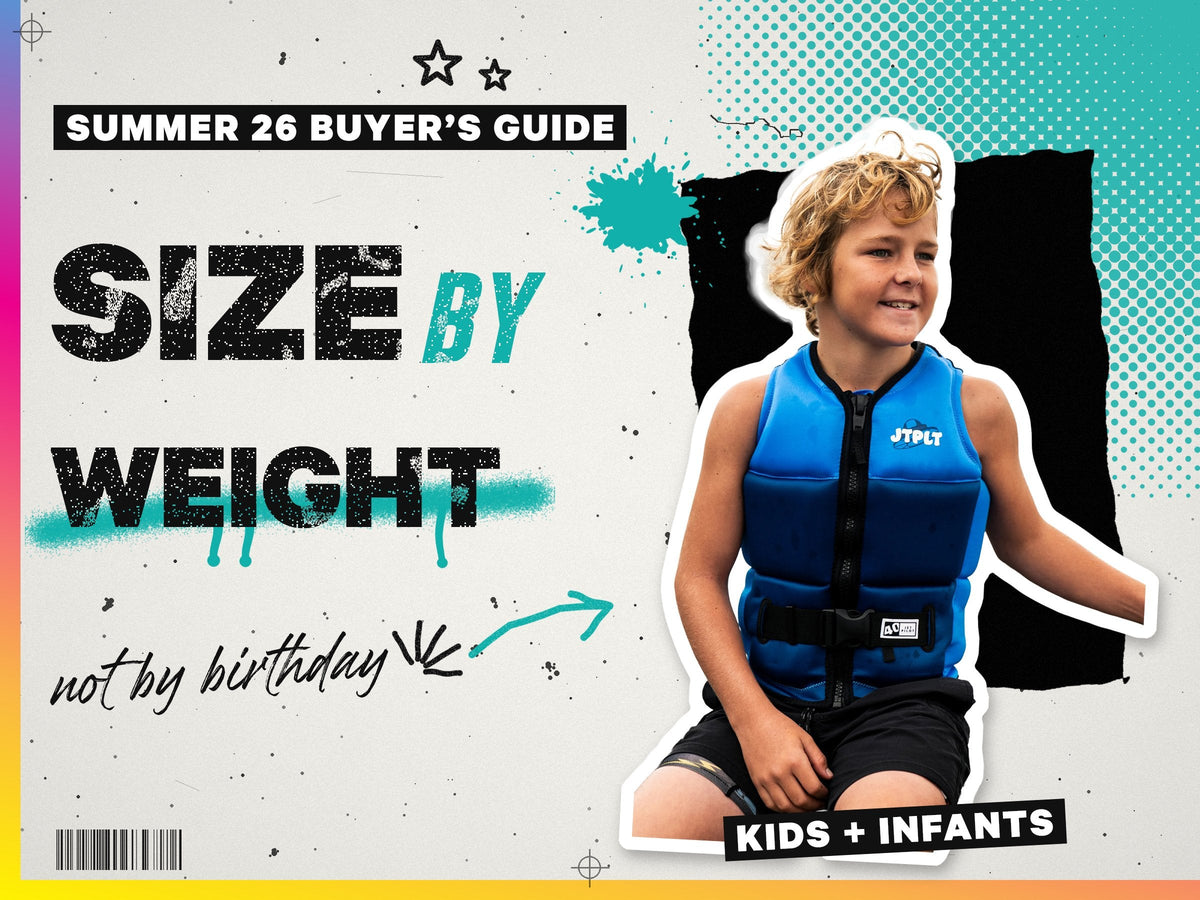
Short answer: Size a child's life jacket by weight, not age, then do up every zip, buckle and strap. Jetpilot's kids' and infant vests are Level 50S or high-vis Level 50. On calm water, they're right for jet skis, tubing and paddling. In a powerboat on open water, every state wants kids in a Level 100 or higher. When kids must wear one depends on your state, your boat and your water. Always actively supervise kids in, on and around water.
Jump to
Groms grow fast. The vest that fitted last summer might not fit this one, and the size on the label is only half the story. The other half is the bathroom scales, the buckles, and a two-minute check at home before anyone goes near the water.
This guide sorts the Jetpilot kids' and infant range by age and weight, then shows every vest up close: what it's for, what it does well, and the questions parents ask before they buy. After that come the fit check and the rules for kids on boats and jet skis, state by state.
Jetpilot has been making gear for riders since 1986, and it's trusted by world champions in jet ski racing, wakeboarding and wakesurf. Every kids' and infant vest in this guide is foam and approved to Australian Standard AS 4758, so it floats the moment it hits the water, with nothing to pull and nothing to service.
Which vest for which kid
Start with who's wearing it, then check the size against their weight. The table splits the range into four stages, from a baby's first boat trip to a teenager riding behind the boat.
| Who it's for | Vests |
|---|---|
|
Babies 1-2 · 10–15 kg
|
Cause InfantCause Infant (No Pillow) |
|
Toddlers 2-6
|
Paddle Pal Splash Kids Life JacketPaddle Pal Splash Swim Vest |
|
Kids 3-4 to 12-14
|
The Cause KidsCause KidsCause Boys |
|
Youth 8 to 16
|
Freeride BoysFreeride GirlsX1 GirlsX1 NASA Boys |
All Level 50S, except the high-vis Level 50s: The Cause Kids Red and Yellow, and the Cause Infant Yellow.
Treat the stages as a starting point, not a rule. A solid six-year-old can already be in a size 8-10, and a light ten-year-old can still sit in a 4-6. That's why the next section starts with the scales, not the birthday.

Size by weight, not age
The numbers on a kids' vest look like ages, but the weight range is what counts. Weigh your child, then pick the size whose range they fall into. Where two sizes share a weight range, measure the chest: under the arms, around the fullest part, with the tape level across the back.
The Cause range (infant, kids and boys) uses this chart:
| Size | Weight | Chest |
|---|---|---|
| 1-2 | 10–15 kg | 52 cm |
| 3-4 | 15–25 kg | 58 cm |
| 4-6 | 15–25 kg | 68 cm |
| 8-10 | 25–40 kg | 74 cm |
| 12-14 | 40–60 kg | 85 cm |
The Freeride youth vests come in sizes 8 to 14, and to 16 in some boys' colours, and the X1 youth vests run 8 to 14 with their own chart on the product page. The Paddle Pal Splash comes in size 2-6. Fit them all with the check below.
Don't buy a size up for them to grow into. Marine Safety SA warns that a jacket that's too big can let a child slide out, and one that's too small may not keep them afloat. A vest that fits this summer is worth more than one they'll fit next summer.
Level 50S or Level 50?
Level 50S is the standard kids' vest. Level 50 is the same float in high-vis colours, so kids are easier to spot, and Queensland requires it on a jet ski beyond smooth water. In the Jetpilot kids' range, the Level 50s are The Cause Kids Red and Yellow and the Cause Infant Yellow. Everything else is Level 50S.
On calm water, both suit jet skis, tubing and kayaks. A family powerboat is different. There, a 50S kids' vest only counts on calm, sheltered water in four states: NSW enclosed waters, Queensland smooth water, Victorian inland waters and SA's protected waters.
In a powerboat on open or coastal water, every state wants kids in a Level 100 or higher. Tasmania doesn't accept a 50S on a motorboat at all, and WA requires a Level 100 or higher on any boat with a motor. Jetpilot's kids' vests are Level 50S and 50, so for open-water boating your kids need a Level 100 or higher.
More on the difference in the jet ski life jacket buyer's guide and our guide to Australian life jacket rules.
What goes into a Jetpilot kids' vest
A kids' vest has a harder job than an adult's: it has to fit a body that keeps growing, stay on a child who'd rather not wear it, and survive a summer of beaches and boat floors. Here's how the Jetpilot kids' range handles each of those jobs.
Performance: built to move with them
Kids don't sit still in a vest, so the youth range is built to move. The Freeride Boys and Girls use a stitch-through block design that gives the vest a thinner profile, which means less bulk around the chest and arms when they're climbing back on the boat or getting up on a board.
Inside the Cause, Freeride and Paddle Pal vests, Freelite bevelled-edge buoyancy foam keeps the profile low and the flex high. The float works with a child's body rather than boxing it in, which matters when they're paddling, swimming or sitting in the boat for hours.
Comfort: a vest they'll keep on
A vest only works on a child who's wearing it, so comfort matters more for kids than for anyone. The Paddle Pal Splash, the Cause Kids prints, the Cause Boys and the Freeride and X1 youth vests have an Ecoprene shell, which Jetpilot describes as lightweight, ultra-soft and tough where it counts, and rates 30% lighter than traditional neoprene.
The details help too. The Paddle Pal Splash has a soft polyester lining that stops chafing, the Cause Infant has a neoprene head pillow that supports your baby's head, and the Cause kids' vests use a relaxed multi-fit cut that's easy to get on a wriggling grom.
Safety: the standard, then the details
Every kids' and infant vest here is approved to Australian Standard AS 4758, at Level 50S, or Level 50 in the high-vis colours. That's the baseline. What sets a kids' vest apart is the hardware a parent can check in ten seconds.
The Cause Infant has a head pillow, two buckles and a safety strap between the legs. The Cause kids' vests have a crotch strap on the smaller sizes, and the Paddle Pal Splash closes with a child-safe lock buckle that stays done up until you undo it.
Innovation: new materials and new shapes
Jetpilot introduced Ecoprene in 2022, and most of the kids' range now has an Ecoprene shell. The Freeride youth vests add the new stitch-through design, and the Paddle Pal Splash wraps a soft collar around the neck instead of a bulky front.
The same push runs right through the brand. Jetpilot introduced its patented Supergrip handles in 2012, and its Pro-Tech race protection won a 2025 Good Design Award for innovation in safety and design of wetsuits and life jackets for watercraft riders.
Built to last, and sustainability
Kids are hard on gear: vests get dragged up beaches, left in the sun and stuffed into boat lockers. The kids' range is built for it, with Ecoprene shells that are tough where they count, a durable YKK zip on the Freeride youth vests, and graphics sublimated into the fabric so the colours outlast the season instead of peeling off. Jetpilot's sustainability page puts the thinking plainly: gear designed to last, with the emphasis on quality, durability and a long life rather than fast fashion.
The material does part of the work too: the outer shell of Jetpilot's Ecoprene vests is made from recycled plastic bottles. Care does the rest. A vest that's rinsed, dried in the shade and stored out of the sun lasts longer, and a well-kept vest can be handed down to a younger sibling once the first grom grows out of it.
The range, up close
Every vest in the kids' and infant range, photographed in the studio so you can see the details: the buckles, the straps, the zips and the prints kids actually want to wear.
For each one, here's what it's for, what it does well, and the questions parents ask before they buy.
Cause Infant and Cause Infant (No Pillow)

The Cause Infant is Jetpilot's smallest vest, made for babies from 10 to 15 kg on pool days, beach days and boat days. It comes two ways: with a neoprene safety pillow that supports your baby's head, or without it, as the Cause Infant (No Pillow).
Two buckles and webbing, a wide neoprene strap and a safety strap between the legs hold the vest snug, and the safety strap is there to keep it from riding up. The pillow version comes in Blue, Pink Tie Dye and Orange/Blue at Level 50S, plus a high-vis Yellow at Level 50. The No Pillow version comes in Blue and Fairy Floss, both Level 50S.
Worried a vest will bother a baby who's never worn one? Jetpilot's advice is that it should feel snug when it's dry; it gives a little once it's wet. Try it on at home first and clip the strap every time. And remember the Cause Infant starts at 10 kg, so a smaller baby needs a jacket made for their weight.
Paddle Pal Splash

The Paddle Pal Splash is the toddler vest, size 2-6, for pool, beach and boat days with toddlers. It comes as the Paddle Pal Splash Kids Life Jacket in Blue, Green and Pink, and the Paddle Pal Splash Swim Vest in Blue and Tie Dye. Despite its name, the Swim Vest is an AS 4758 Level 50S life jacket too.
A soft collar wraps around the neck instead of a bulky front, and a soft polyester lining stops chafing on bare skin. The child-safe lock buckle stays done up until you undo it, and the flexible shape lets little ones twist, turn and splash without restriction.
Swim aid or life jacket? It's a life jacket: Ecoprene outside, Freelite buoyancy foam inside, approved to Level 50S. Swim aids and floaties aren't life jackets, so check the label on anything else you're handed at the pool. The vest's own label also gives the weight range for the 2-6 size, so check it against your child before the first swim.

The Cause Kids

The Cause Kids is the all-rounder for kids from 15 kg up, built for beach play, family boat days and watercraft outings. Jetpilot says it has refined the Cause over 20 years for comfort, durability and performance, and this is the version sized for young riders, from 3-4 to 12-14.
A front zip and two buckles with sturdy webbing make it quick to put on and easy to adjust. Mesh drainage gussets let water flow out so the vest doesn't stay heavy, and child sizes add a neo-padded safety strap. It comes in Blue, Pink and Charcoal at Level 50S, and in high-vis Red at Level 50.
Will they grow out of it by Christmas? Size by weight, not age. The 3-4 and 4-6 share a 15–25 kg range, so measure the chest to choose between them, and don't size up for next year. The vest that fits now is the one that works.
Cause Kids prints

Same Cause build, louder prints: Monster Blue, Monster Green and Pirate Black in the boys' styles, and Fairy Floss, Purple and Tie Dye in the girls'. If getting a vest on your grom is the daily battle, a print they picked themselves is half the fight won.
Under the prints it's full Ecoprene construction, with a front zip, two buckles and webbing, mesh drainage gussets and a neo-padded safety strap on child sizes, all at Level 50S. Sizes run 3-4 to 12-14 on the same chart as the rest of the Cause range.
Bright prints don't change the level: every print here is Level 50S. If your water calls for Level 50, The Cause Kids in high-vis Red is the one to look at.
Cause Boys

The Cause Boys is new for summer 2026, with fully sublimated character artwork and 40-year branding. It's made for PWC and boat days, tubing and first rides, and for growing groms, in Black/Blue, Green and Red.
It has an Ecoprene shell with Freelite bevelled-edge buoyancy foam, a front zip, two buckles, mesh drainage gussets and a neo-padded safety strap on child sizes. The graphics are sublimated into the fabric, so the colours outlast the season instead of peeling off it.
Red here is a colour, not a level: every Cause Boys vest is Level 50S. Sizing follows the Cause chart, from 3-4 for 15–25 kg up to 12-14 for 40–60 kg.
Freeride Boys and Freeride Girls

The Freeride is Jetpilot's wakeboard vest, sized down for groms learning to ride and tubing behind the boat. The new summer 2026 Freeride Boys runs sizes 8 to 16 in Black, Blue and Midnight Black, alongside last season's boys' colours and the Freeride Girls in Charcoal, Multi and Teal, sizes 8 to 14.
The stitch-through design gives it a thinner profile, cutting bulk while boosting mobility, and Freelite bevelled-edge foam and a durable YKK zip keep it secure through bombs, tube wipeouts and endless re-boards. Its Ecoprene shell, which Jetpilot rates 30% lighter than traditional neoprene, is made from recycled plastic bottles.
Feels tight in the shop? That's right: Jetpilot's advice is that it should feel snug when dry and relax once it's wet. Check the weight range on the vest's label against your child, then run the fit check at home before the first set.
X1 Girls and X1 NASA Boys

The X1 youth vests bring Jetpilot's X1 wake line down to kids' sizes 8 to 14: the X1 Girls in Multi and the X1 NASA Boys in Black/Blue, with the NASA patch on the front.
Both have an Ecoprene shell, Freelite bevelled-edge buoyancy foam, an anatomical fit and a durable PK Lok zip, approved to Level 50S. They size on the X1 youth chart on each product page: by weight first, then chest.
Babies on the water
Queensland, Victoria and WA advise against taking babies boating. If you do, choose a vest sized by weight with head support and a crotch strap, and keep hold of your baby the whole time.
The Cause Infant starts at 10 kg. For smaller babies, Transport for NSW notes that the smallest Australian Standard life jackets start at 5 kg. If your baby is too small for one, it advises you wear a life jacket yourself and hold your baby the whole time.

On the vest itself, three things do the work. The head pillow on the Cause Infant supports your baby's head, the two buckles and webbing hold the vest snug, and the safety strap between the legs is there to keep it from riding up. Clip that strap every time, even for a quick paddle in the shallows.
Give your baby time to get used to the vest before the day you need it. A few minutes on the lounge room floor, then a dip in a warm pool with you holding on, makes the first boat trip a lot calmer for everyone.

The 60-second fit check at home
A vest only works if it fits, and kids change shape faster than the seasons. Run this check at home with the vest you've bought, before the first trip, and again at the start of every summer.
- Weigh and measure. Pick the size by weight, and by chest if two sizes overlap.
- Zip and buckle. Do up the zip, then every buckle, and pull the straps snug.
- Clip the safety strap on infant vests and child-size Cause vests.
- Lift test. Lift the vest at the shoulders. It shouldn't ride up past the chin or ears, and your child shouldn't be able to slip out.
- Re-check every season. Kids grow, and last summer's vest may not fit this one.
Jetpilot's own fit advice is blunt: a child's vest should feel snug when it's dry. It relaxes a little once it's wet, and a vest that's loose around the shoulders can ride up or even slip off when they hit the water.
That safety strap is the crotch strap regulators in six states recommend for kids. SA and Queensland also suggest a practice run: try the vest on at home, then test it in a pool, jumps included, before the first trip.
More detail in how to correctly fit your life jacket.

Kids on boats and jet skis: the rules
When kids must wear a life jacket on a boat depends on your state, your boat and your water. There's no single national rule:
- NSW: under 12, at all times in a boat under 4.8 m, and in the open areas of a boat under 8 m while it's underway.
- Queensland: aged 1 to 11, in an open boat or the open areas of any boat while it's underway.
- Victoria: under 12, in the open areas of powerboats up to 12 m, yachts, jet skis, canoes and kayaks while underway.
- SA: 12 and under, on a motorboat up to 4.8 m and in the open areas of a boat up to 12 m, underway or at anchor.
- WA: aged 1 to 11, in the open areas of a boat more than 400 m from shore, outside rivers, lakes and estuaries.
- Tasmania: everyone on a motorboat under 6 m under power, and kids under 12 on bigger motorboats under power, except inside the cabin.
- NT: under 16, but only on a jet ski or a small sailing boat. We'd put one on them every trip anyway.
If you're the skipper, making sure the kids wear theirs is your legal job.
On a jet ski, kids must wear a life jacket in every state and territory. In NSW a child aged 1 to 12 counts as a full seat, and Queensland advises kids ride behind you with both feet in the footwells.
Rules change, and some depend on how far you are from shore, so treat this as the short version and check your state's maritime authority before you head out.
Sun, heat and the rest of the kit
A vest is only part of the kit. Jetpilot's own checklist for a day on the water starts with life vests for everyone aboard, then water, sun protection, the tow rope and a fuelled-up boat or ski. On an Australian summer arvo, the sun is the one parents forget until the drive home.
The new summer 2026 youth rashies pair well with a vest. The Youth Boys Long Sleeve Rashie and the Youth Girls Long Sleeve Rashie Set are rated UPF50+, and the Youth Boys Long Sleeve Hydro Tee is Jetlite micro jersey, also UPF 50+. Put the rashie on first, then the vest, and run the fit check over the top, because a rashie changes how the vest sits.
Looking after kids' vests
Rinse the vest in fresh water after the beach or the pool, dry it in the shade, and store it out of the sun. Salt and sun are hard on any vest, so a two-minute rinse and a proper dry go a long way.
Before the first arvo on the water each season, check the zip, buckles, straps and foam. Replace any vest that's damaged or outgrown: a vest that's too small for your child isn't doing its job, however good it looks.
Hand-me-downs get the same check, plus a look at the label: older AS 1512, 1499 and 2260 jackets no longer count in Queensland, SA or Tasmania. A vest that's been cared for can see a younger sibling through the same size once the first grom grows out of it, so long as the label is readable and the weight range matches.
FAQs
What size life jacket does a 2 year old need?
Go by weight, not age. The Cause Infant 1-2 suits 10 to 15 kg, and the Paddle Pal Splash comes in size 2-6. Over 15 kg, look at the Cause Kids 3-4, for 15 to 25 kg.
Two-year-olds vary a lot, so weigh yours, then run the fit check at home: zip and buckle up, then lift the vest at the shoulders to make sure it doesn't ride up past the chin or ears.
Can a baby wear a life jacket?
Yes, if it's sized for them. Jetpilot's smallest vest is the Cause Infant 1-2, for babies from 10 to 15 kg, with a head pillow and a safety strap between the legs.
Queensland, Victoria and WA advise against taking babies boating. If you do go, keep hold of your baby the whole time, and for a baby under 10 kg, look for a jacket made for their weight.
Do kids have to wear a life jacket on a boat?
It depends on your state, your boat and your water. Most states set the age at under 12, with rules that turn on the boat's size, its open areas and whether it's underway.
SA includes 12-year-olds, Tasmania covers under-16s on motorboats under 6 m, and the NT only sets kids' rules for jet skis and small sailing boats. On a jet ski, kids wear one in every state and territory.
What level life jacket does a child need?
On calm water, Level 50S suits jet skis, tubing and paddling, and Level 50 is the same float in high-vis colours for kids who need to be easier to spot.
In a powerboat on open water, every state wants kids in a Level 100 or higher, and Tasmania doesn't accept a 50S on a motorboat at all.
Can kids ride on a jet ski?
Yes, as passengers, and every state and territory requires them to wear a life jacket on the ski.
In NSW a child aged 1 to 12 counts as a full seat, and Queensland advises kids ride behind the rider with both feet in the footwells.
Are inflatable life jackets OK for kids?
For young kids, choose foam. NSW and Tasmania advise against inflatables for under-12s, and SA law doesn't accept manual inflatables for kids under 12 or under 40 kg.
None of Jetpilot's kids' or infant vests are inflatable. Foam floats the moment it hits the water, with nothing for a child to pull and nothing to service.
Do kids need a life jacket on a tube?
Yes. Tube riders must wear a life jacket in every state and territory except WA, where it's recommended, and a Level 50 or 50S vest meets the rule wherever a level is set.
SA and Tasmania don't allow inflatable life jackets for towed riders, so put kids in a foam vest that fits, and keep the speed down: a rider on a whip moves far faster than the boat's speedometer shows.
How do I know if my child's life jacket fits?
Do up every zip, buckle and strap, then lift the vest at the shoulders. It shouldn't ride up past the chin or ears, and your child shouldn't be able to slip out.
If it rides up, tighten the straps or go down a size. A snug fit on dry land is right: the vest relaxes a little once it's wet.
Find their vest
Weigh them, size them, zip and clip. Then get the crew on the water, with a grown-up watching every lap.
Every vest in this guide sits in the kids' and infant collections, with the size chart on each product page. Stuck between two sizes? Weigh your child, measure the chest, and go with the size whose weight range they sit inside.
Shop kids' life jackets · Infant and baby life jackets · Jet ski life jacket guide

