




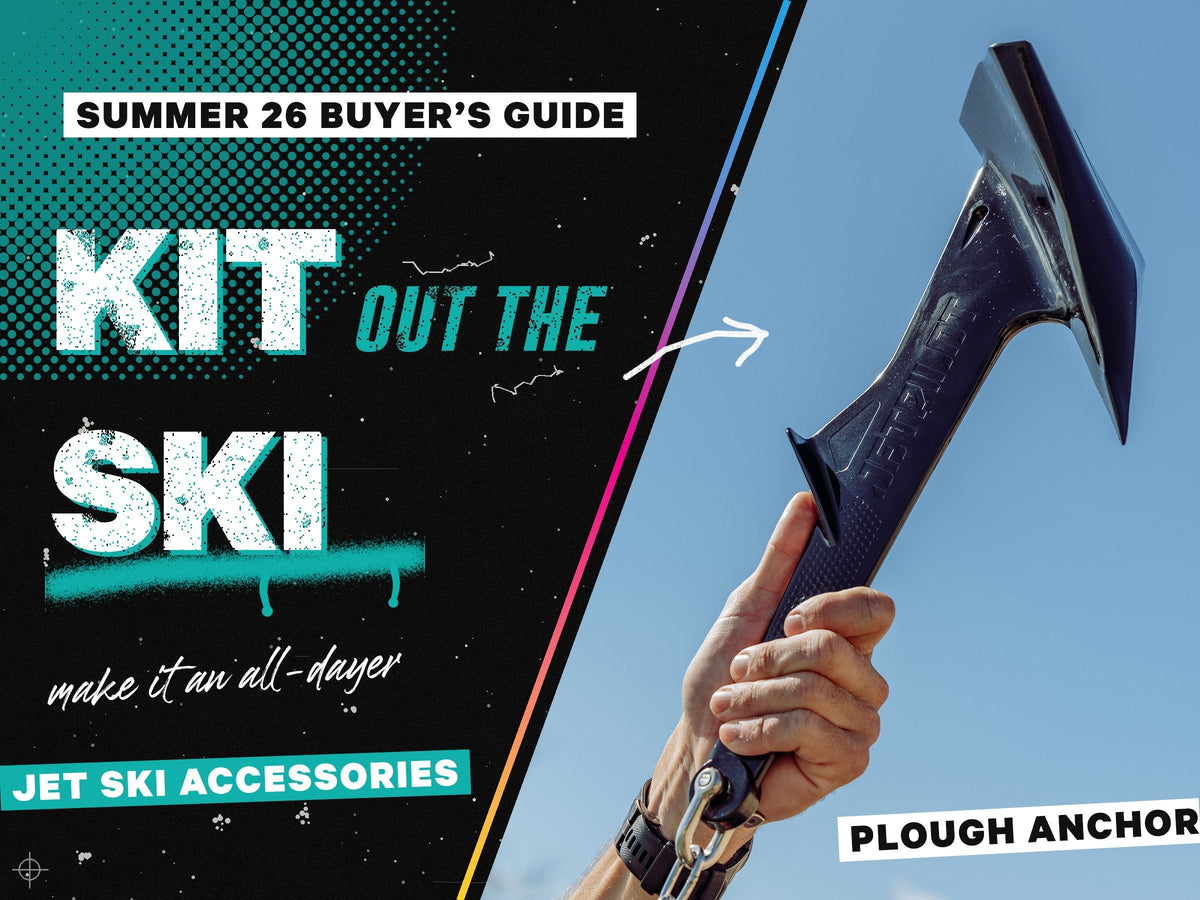
Short answer: The best jet ski accessories solve the day's real problems, in this order: fenders and dock ties to protect the hull, a handle bar bag and dry bags for your phone and keys, an anchor that suits where you stop, a cooler for lunch, and a small safety kit. Those are the jet ski essentials. What the law makes you carry depends on your state: NSW, SA and the NT ask for nothing beyond the lifejacket you wear, Victoria wants a waterproof, buoyant torch on every ride, and Tasmania a fire extinguisher.
Jump to
These are the must-have jet ski accessories, in the order you'll need them. A new ski comes with a lanyard, a manual and nowhere to put anything, and the first summer usually fills the gaps the hard way: a phone drowned in the storage bin, a hull scuffed on the pontoon, an anchor that dragged off the sandbar while everyone was swimming.
This guide sorts the jet ski equipment that matters into a six-step setup checklist, with what the law in your state asks you to carry and what to wear on the ski. Then it shows Jetpilot's Summer 26 jet ski accessories up close, including pieces still on their way from the factory. Jetpilot has made gear for riders since 1986, and Summer 26 marks 40 years.
The jet ski setup checklist: the best accessories, in order
Most jet ski gear solves one of five problems: the hull meeting the pontoon, the phone meeting the water, the ski drifting off the sandbar, lunch going warm, and small safety gear rolling around loose. Buy in that order, and you're paying for problems you'll actually have.
The table matches each job to the Summer 26 kit. Starting from nothing, the Essentials Watercraft Kit covers the first jobs in one box.
| The job | The Summer 26 kit |
|---|---|
|
Start from scratch One box
|
Essentials Watercraft Kit |
|
Protect the hull at the pontoon Pontoon
|
Flexi FenderNEWBungee Dock Tie Twin Pack |
|
Hold at the sandbar or beach Sand
|
Plough AnchorFluke AnchorSand Anchor |
|
Anchor in deeper water Offshore
|
Offshore Jet Ski AnchorNEWFolding Anchor (calm water) |
|
Phone, keys and wallet Within reach
|
Venture Handle Bar BagEssentials Tote (Sea-Doo)Drysafe bags |
|
Clothes, towels and lunch Big carry
|
50L Waterproof Backpack70L Oversized Tote |
|
Keep lunch cold On the ski
|
Venture CoolerVenture Soft Esky |
|
Small safety gear Every ride
|
Venture Marine Safety KitFloating Wristband |
|
The ramp and the beach Launch day
|
Floating Bung Tool (Sea-Doo)Strong Arm Straps |

1. Protect the ski: docking accessories and beach handling
Most damage to a ski happens standing still: against a pontoon, a jetty or another ski, or dragged across sand. Protection starts with two docking accessories, fenders and dock ties, and a way to move the ski on the beach without grinding the hull.
One more line on protection: take the key and lanyard with you whenever you leave the ski. It's the simplest theft deterrent there is.
Fenders and dock ties
Hang fenders where the hull would touch first, at its widest point. Jetpilot recommends two Flexi Fenders per ski, and their three hinged sections and elastic quick-attach make them quick to hang at the ramp and quick to pull off before you ride.
Then tie off with some give. The Bungee Dock Tie Twin Pack uses 80cm of elastic bungee in a nylon cover, so the line stretches with passing wash instead of jerking the ski, and PVC tubes protect the finish where it rubs. Tie bow and stern, short enough that the ski can't swing under the boards.
Moving the ski on the beach
A ski is heavy on sand, and dragging it by a grab handle is hard work. The Strong Arm Straps hook onto a solid point like the bow eye and give you a padded handle, and the Dual Strong Arm Strap adds a second strap for a side-stance pull or a two-person haul.
Move it with the engine off, keep the hull clear of rocks, and never pull it by the handlebars.
2. Storage that stays dry, and where it goes
Storage on a ski is limited and wet. The front bin and glovebox take spray every time the bow comes down, so anything that can't get wet needs its own protection, and anything you reach for often needs to sit where you can get it without stopping.
Read the label. Most of Jetpilot's bags are rated water-resistant, which covers spray, splashes and rain. The Charcoal 50L Waterproof Backpack is rated IPX6, a test against powerful water jets rather than a dunking, so keep bags out of the water instead of trusting them under it.

On the bars and in the front storage
The Venture Handle Bar Bag is where a lot of riders start. Your phone sits under a clear touch-screen window, so maps and messages work without unzipping, and Jetpilot says it fits most jet skis. Mount it clear of the kill-switch lanyard and the steering, and on hot days pull the mesh shade over the window, since a phone working hard in full sun can overheat.
On a Sea-Doo RXT, RXT-X, GTX or WAKE Pro from 2018 on, the Essentials Tote clips into the front storage with four fasteners, so 45 litres of gear stops sliding around the bin. On other skis, a Drysafe bag or two in the bin does the same job.
Drysafe bags and the 50L backpack
Drysafe bags come in 2L, 5L and 10L, each with a roll-down watertight closure and sonic heat-welded seams. The 2L takes a phone and keys, the 5L adds a wallet and a shirt, and the 10L Drysafe Backpack has room for a V-sheet and flares if your state or your trip calls for them.
For the walk from the car with towels, clothes and lunch, the Charcoal 50L Waterproof Backpack is the IPX6-rated one, with adjustable straps and a padded mesh back. The 70L Oversized Tote is the bigger, simpler carry, and its stock is on its way.
3. Anchor and moor: pick the anchor by the bottom
Where you stop decides the anchor. On a sandbar or beach you need something that digs into sand; in deeper water you need more line and more weight; on rock or weed you need a grapnel. A rope tied to the wrong anchor is how a quiet arvo turns into a swim after a drifting ski.
Whatever the bottom, set the anchor off the bow, let the ski settle back on the line, and check it's holding before you walk away. Never anchor from the stern.

Sand and the sandbar
The Plough Anchor is a 1kg anchor with a wide sand scoop that digs in as the line comes tight, with 2m of stainless chain to keep the pull low along the bottom. The Lightweight Fluke Anchor is the light option at 0.79kg, and the Sand Anchor is a bag you fill with sand on the spot.
All three suit sheltered water close to shore. If owners have one complaint about small anchors, it's light chain and short rope, so for anything deeper, step up to the offshore anchor.
Deeper water and offshore
The Offshore Jet Ski Anchor, new for Summer 26, is a 1.5kg galvanised fluke anchor on 4m of chain and 20m of rope, 24m in all, made for offshore anchoring. As a rough guide, let out several times the water's depth in line so the pull stays low.
The Complete Folding Anchor System's grapnel is the one for rock and weed, but Jetpilot says plainly it isn't designed for ocean use. Queensland's regulator expects an anchor and line on partially smooth water and beyond, so it's worth carrying even where the law doesn't ask.
4. Keep it cold: Venture Cooler or Soft Esky
A cooler is what turns a quick blast into a day at the sandbar. Jetpilot makes two that ride on the ski: the 25-litre Venture Cooler and the roomier Venture Soft Esky. Both strap on through connection points with no drilling, both have two rod holders with bungee locks, and Jetpilot lists both for Sea-Doo, Yamaha and Kawasaki.
The Venture Cooler is the compact one, 39 x 23 x 28cm inside, with sonic-welded seams and an easy-glide seal zip; the Soft Esky is roomier at 42 x 24 x 32cm inside. Strap it to solid points, keep the weight low and central, and protect the paint where straps cross it. The rod holders make either one part of a jet ski fishing setup.

Jetpilot doesn't publish ice-retention times, so chill it overnight, pack it full and keep it out of the sun. Frozen water bottles beat loose ice, and you'll have cold water for the ride home.
5. Safety gear: what your state makes you carry
On a jet ski, the law cares most about what you wear. Every state and territory sets lifejacket rules, covered in our jet ski life jacket guide. Beyond the lifejacket, the safety gear you must carry depends on your state and how far out you go.
NSW, South Australia and the Northern Territory require nothing else on a jet ski. The other states add a torch, an extinguisher, or flares and a beacon further out, and WA's offshore rules start just 400m from the beach.
| State | Beyond the lifejacket you wear, a jet ski must carry |
|---|---|
| NSW | Nothing else, on any water. Keep the behaviour label on the ski, and no riding between sunset and sunrise. |
| QLD | On smooth water, nothing else, plus a torch or glow stick after dark. More than 0.5 nm out on partially smooth or open water: 2 red flares, 2 orange smoke signals and a V-sheet. Past partially smooth water and over 2 nm from land: an EPIRB, or a GPS PLB you wear. |
| VIC | A waterproof, buoyant torch on every ride. More than 2 nm off the coast: a registered EPIRB (a PLB doesn't count). |
| SA | Nothing else. Keep the Ride Smart sticker on, stay within 2 nm unless the department approves, and ride from 8 am (9 am Sunday) until sunset or 8 pm. |
| WA | Nothing else within 400 m of shore or on rivers and estuaries. Further out in the ocean: an EPIRB or a PLB on you, and 2 red and 2 orange flares or an approved electronic flare. Beyond 4 nm: a marine radio. |
| TAS | A fire extinguisher on every ride, and daylight riding only. On coastal sheltered water, flares or an electronic flare kit. Beyond sheltered water: a beacon, VHF radio, tow line and parachute flares. |
| NT | Nothing else to carry, but the kill-switch lanyard must be attached to you on every ride. |
| ACT | On paper, the general boat list: whistle, waterproof torch, extinguisher, anchor, paddle and a bailer. Check with Access Canberra before you ride. |
We checked this table against each state's regulator and legislation in October 2026. Rules change, and local waterways add their own, so check your state's maritime authority before the season.

The kill-switch lanyard
Every state's regulator and the NT tell you to wear the kill-switch lanyard, attached to you and the ski, whenever the engine is running. In the Northern Territory it's the law on every ride, and in Queensland when a licence holder supervises an unlicensed driver.
If the lanyard lives on your wrist, the Floating Wristband gives it a padded neoprene strap and a D-ring, made for the Sea-Doo lanyard. Clip on before you start the engine, and if the ski won't start, check the lanyard first.
The Venture Marine Safety Kit, and riding further out
The Venture Marine Safety Kit isn't a complete legal kit for any state. It's the small gear that's useful on any water: a 6m tow rope for getting a broken-down ski home, a water-resistant torch, a whistle, and a container that works as a bailing bucket. In Victoria, check that your torch is waterproof and buoyant, because that's the wording of the rule.
The rules tighten with distance. More than 2 nautical miles off the Victorian coast you need a registered EPIRB, and a PLB doesn't count; Queensland, WA and Tasmania accept a PLB on a jet ski, with conditions. Night riding is out in NSW, South Australia and Tasmania, and anywhere else a ski needs proper navigation lights, which most skis don't have from the factory.
6. Ramp to home: bungs, towing kit and the drive back
Plenty of ski days go wrong before the ski is even wet. Every regulator's checklist says the same thing before you launch: check the bungs are in and tight. Do it in the rigging lane, with the rest of your checks, so the ramp stays clear.
On a Sea-Doo, the PWC Floating Bung Tool takes the fight out of the drain bungs, with a grip that works with wet hands and spare bung screws stored in the handle. It floats, which counts for a lot at a ramp.
Towing kit
If the ski tows a tube, the towing kit is a rope made for towables, a tube that suits your riders, and an observer on board, which every state and the NT require. Our ski tube buyer's guide covers the tubes, ropes, pumps and the towing rules state by state.
Check your ski is rated to carry the rider and the observer, and keep the rope clear of the jet intake when you start up and when you pick up a rider.
On the road: tie it down
A load that isn't restrained to the national performance standards is illegal on the road, and a ski on a trailer is a load. The national Load Restraint Guide's advice for boats is a purpose-built trailer, the winch rope plus a safety chain at the bow, and a strap over the stern, and the same method suits a ski.
Check the straps at your first stop, since lashings lose tension as the trip goes on, and leave the winch and safety chain on until the ski is in the water.
What to wear on a jet ski: the gear you ride in
Accessories set up the ski; what you wear sets up the rider. Start with a lifejacket at the level your state requires for where you ride, zipped and buckled, with the kill-switch lanyard clipped to you. Our jet ski life jacket guide covers the levels state by state.
Then dress for sun and water: a rashie (Jetpilot's rashies are UPF 50+), boardies or neoprene shorts, water shoes for the ramp and rocky beaches, and sunnies on a floating retainer so a spill doesn't cost you a pair. When the water turns cold, a springsuit or wetsuit top goes under the vest; size the vest with that layer on. The full range is in the Watersports Summer 26 collection.
What goes into Jetpilot accessories
The accessories come from the same place as Jetpilot's vests: riders telling the designers what broke, what slipped and what they wished they had. In Jetpilot's own words, "We continuously create adjustments based on feedback from the people using our gear the most."
Here's how that shows up across the Summer 26 accessories, in the five things Jetpilot builds every product around.
Performance
Performance in an accessory means it works on the ski, wet and moving, rather than looking good on a shelf. The coolers and the Handle Bar Bag are listed for Sea-Doo, Yamaha and Kawasaki skis, the Essentials Tote clips into four Sea-Doo models, and the Offshore Jet Ski Anchor comes as a complete 24m system.
Jetpilot is trusted by world champions across jet ski racing, wakeboarding and wakesurf, and that background shows in the everyday kit: hardware that works with wet hands, and gear that stays put on the ski.
Comfort
Comfort shows up in the details you notice after a long day: the padded mesh back on the 50L Waterproof Backpack, the neoprene padding on the Floating Wristband, and the Dual Strong Arm Strap's side-stance setup, which lets you pull from your body's strongest position.
Off the ski, the Back Rest Chilled Seat Bag folds out into a seat with a backrest, rated to 110kg, with a 10-litre cooled bag built in, so the beach stop is a proper break.
Safety
The accessories don't replace the rules or the lifejacket, but they make the safe habits easy. The hi-vis floats on the anchor ropes make the line easy to see, the Floating Wristband keeps the lanyard with you, and the Venture Marine Safety Kit keeps a tow rope, a torch and a whistle in one container.
The bung tool and the dock ties do quieter work: bungs that go in properly at the ramp, and a ski that stays tied up when the wash comes through.
Innovation
Some of the range rethinks small jobs. The PWC Floating Bung Tool is 3D-printed in marine-grade ASA plastic with spare bung screws in its handle, and the Flexi Fender's three hinged sections and elastic quick-attach change how a fender goes on and comes off.
The Handle Bar Bag's touch-screen window means your phone works through the bag, and the Essentials Tote's four clips turn a Sea-Doo's front bin into organised storage instead of a pile.
Built to last
The materials are picked for salt and sun: 316 marine-grade stainless chain on the Plough Anchor, hot-galvanised steel with a vinyl coating on the Offshore anchor, 304 stainless hardware, and sonic heat-welded seams on the bags and cooler.
Many of the bags are made from 600D durable PET recycled material, and in Jetpilot's words, "We make clothing and water sports products that are designed to last." Rinse everything in fresh water after a salty day and dry it out of the sun, and it will stay in good shape for longer.
The Summer 26 accessories range, up close
Here's the Summer 26 accessories range in the studio, in checklist order. Each card covers what it's for, what it's built with, and the questions owners ask before they buy.
Anything sold out or still coming from the factory links to the collection it will land in; everything else links straight to the product.
Essentials Watercraft Kit: the starter box

The Essentials Watercraft Kit is the box to grab with a new ski, or the day you notice the old one has never had its kit sorted. It puts the jobs most riders cover first into one pack: two PWC fenders, the PWC Bungee Dock Tie Twin Pack, the Jetpilot Plough Anchor and the Venture Marine Safety Kit, with a Jetpilot wristband for the lanyard key.
Each piece does its own job: the fenders cushion the hull at the pontoon, the dock ties take up the ski's movement on the line, the anchor's wide sand scoop digs in at the sandbar, and the safety kit carries a 6m tow rope, a water-resistant torch and a whistle in a container that doubles as a bailing bucket.
Is it everything your state asks you to carry? No starter box can promise that, because each state sets its own list, and items like an EPIRB offshore sit outside any kit. Check the safety section above, and if you already own an anchor or fenders, buy the missing pieces on their own: every item in the box is sold separately.
The Essentials Watercraft Kit, unboxed
Flexi Fender: three hinges, quick to hang

A fender is the first thing between your hull and the pontoon, the boat ramp jetty or another ski. The Flexi Fender is new for Summer 26: a durable nylon fender built in three hinged sections, so it can follow the side of the ski rather than sitting as one stiff block.
It hangs from a moulded acetyl hook on Jetpilot's elastic quick-attach system, so it's quick to put on at the ramp and quick to pull off before you ride. Jetpilot recommends two per ski for complete protection: hang the pair at the widest point of the hull, and check them once the first boat's wash has gone through.
Bungee Dock Tie Twin Pack: give on the line

A rope tied tight to a cleat jerks the ski every time a boat goes past. The PWC Bungee Dock Tie Twin Pack swaps that for 80cm of elastic bungee cord inside a durable nylon cover, so the line stretches with the wash and pulls the ski back gently.
Each tie carries two 15cm Jetpilot floats, and PVC tubes on the line protect the ski's finish where it rubs. Two ties come in the pack, enough for bow and stern, and they're in the Essentials Watercraft Kit too. Pair them with a fender on the pontoon side, so the hull has padding as well as give.
Plough, Fluke and Sand Anchors: for the sandbar

A lot of ski days end at a sandbar, a beach or a quiet bay, and these two are built for that. The Plough Anchor is a 1kg nylon anchor with a lead self-locating tip and a wide sand scoop, on 2m of 316 marine-grade stainless chain and marine-grade poly rope with three loops at 1.5m intervals so you can shorten the line. The complete system weighs 2.25kg, with a hi-vis float on the rope.
The Lightweight Fluke Anchor is the light option: a 0.79kg fluke-style anchor with a thick vinyl coating that protects the ski's finish, on 7.6m of marine-grade rope. The PWC Sand Anchor works a different way, a heavy-duty 600D nylon bag you fill with sand or rock, with 6m of poly rope, a float and an attachment clip.
All three are for sand and sheltered water; for deeper water, see the Offshore Jet Ski Anchor below. The Summer 26 Sand Anchor is on its way from the factory in Blue and Black, so the link goes to the fenders and anchors collection, where it will land.
Offshore Anchor and Folding Anchor: deeper water

Past the sandbar, an anchor needs more line and more bite. The Offshore Jet Ski Anchor is new for Summer 26: a 1.5kg fluke-style anchor in hot-galvanised steel, after Richard Danforth's 1939 fluke design, with a thick vinyl coating that protects the ski's finish.
It comes as a complete system: 4m of galvanised chain with a chain cover and a 304 stainless D-shackle, then 20m of marine-grade poly rope with a hi-vis float and an M10 304 stainless carabiner, for 24m of total anchoring length. The whole system weighs 6kg and packs into its own storage bag between rides.
The Complete Folding Anchor System is the compact one: a 1.5kg coated grapnel in a padded case with 7.6m of line, for rivers, lakes and sheltered bays. Jetpilot says plainly it isn't designed for ocean use.
Venture Handle Bar Bag: the phone on the bars

For a lot of riders the Handle Bar Bag is the first accessory on the ski. It straps to the bars, holds the things you reach for most, and puts your phone under a clear interactive window you can use without unzipping, so the map, the music and your mates' messages stay in reach.
It measures 220 x 120 x 120mm outside, in 600D RPET polyester, with an Airfoam iPhone support and a mesh phone shade on a Velcro connection. Jetpilot rates it as water-resistant storage, which covers spray and splashes; anything that mustn't get wet goes in a Drysafe bag.
Will it fit your ski? Jetpilot says it fits most jet skis and lists Sea-Doo, Yamaha and Kawasaki. Before you strap it on, check it clears your bar controls and mirrors, and keep the kill-switch lanyard free to pull.
Essentials Tote: made for Sea-Doo front storage

Front storage on a ski is a deep, wet compartment where everything slides to the bottom. The Essentials Tote is a 45-litre organiser made to fit it, with four fastener clips that lock it into the front storage of Sea-Doo RXT, RXT-X, GTX and WAKE Pro models from 2018 on.
It's 600D recycled PET with water-resistant panels and mesh that drains water and lets sand fall out, with a phone pocket, a bottle holder and a key hook inside. Not on a Sea-Doo? The clips are made for those four models, so on a Yamaha or Kawasaki it's a tote rather than a fitted organiser.
Venture Drysafe bags: 2L, 5L and 10L

Drysafe bags are for the things that mustn't get wet: keys, wallet, a phone, a dry shirt for the drive home. The Venture range comes in three sizes, the 2L and 5L Drysafe Bags and the 10L Drysafe Backpack, each in 600D durable PET recycled material with a roll-down watertight closure, sonic heat-welded seams, a clear window pocket and a removable shoulder strap.
Jetpilot rates them as water-resistant bags, so treat them as protection from spray, splashes and rain with a sealed top, and roll the closure at least three times before you clip it. The 10L Drysafe Backpack has room for a V-sheet and flares, which makes it a tidy home for the safety gear you carry further out.
Charcoal and Fluro Yellow are the Summer 26 colours, and the 40 Year 5L Dry Bag comes in black with the 40-year branding. The Fluro Yellow 2L is on its way to the dry bags and eskies collection, and a new Venture phone pouch is coming too.
50L Waterproof Backpack and 70L Tote: the big carry

For the all-dayer, when there's a change of clothes, towels and lunch to carry from the car to the ski, the Venture 50L Waterproof Backpack is the one. The Charcoal pack is IPX6 waterproof rated, in 600D durable PET recycled material with sonic heat-welded seams and a roll-down watertight zippered closure, so spray off the bow or a downpour on the walk back stays outside.
It carries like a proper pack, with adjustable straps, a padded mesh back panel and two elastic bottle holders. The 70L Oversized Tote is the bigger, simpler carry, with a sealed zip and a removable mesh insert, and its stock is on its way; the Transit Backpack, with its padded laptop compartment, is the dry-land bag for the trip there and back.
Venture Cooler and Soft Esky: lunch on the ski

Lunch at the sandbar beats packing up at noon, and these two are how it happens. The Venture Cooler is the compact one: a 25-litre Cool Cell soft cooler with sonic-welded inner and outer parts, an easy-glide seal zip and 2.5cm of EPE Cool Cell foam in the body and base, measuring 39 x 23 x 28cm inside.
The Venture Soft Esky is the bigger one, at 42 x 24 x 32cm inside, with 20mm of foam and a heat-sealed PVC lining. Both carry Jetpilot's Multi Connect Low connection points and two rod holders with bungee locks, and Jetpilot lists both for Sea-Doo, Yamaha and Kawasaki skis, so they're built to ride on the back of the ski.
Jetpilot doesn't publish an ice-retention time for either, so pre-chill it, pack it full and keep it shaded. For a beach day off the ski, the Back Rest Chilled Seat Bag folds out into a seat with a 10-litre cooled bag.
Venture Marine Safety Kit and Floating Wristband

The Venture Marine Safety Kit keeps the small safety gear together in one lime container: a 6m tow rope, a water-resistant torch and a whistle, and the container itself works as a bailing bucket. Jetpilot labels it safety equipment for small vessels, and having it in one place means nothing goes missing between rides.
It isn't a complete legal kit on its own: each state sets its own list, so check the safety section above and add what your water needs.
The Floating Wristband is for the kill-switch lanyard: a neoprene and nylon webbing strap with an adjustable Velcro closure and a D-ring you clip the lanyard to, so the lanyard stays with you and the engine stops if you come off. Jetpilot designs it for the Sea-Doo lanyard, and the neoprene padding adds comfort and flotation.
PWC Floating Bung Tool: for Sea-Doo drain bungs

Forgetting the bungs is the classic mistake at the ramp, and fighting them with wet hands comes a close second. The PWC Floating Bung Tool removes and installs Sea-Doo drain bungs (not on the Spark), with a grip that gives you leverage even when your hands are wet. Check your model year against the product page before you buy.
It's 3D-printed in marine-grade ASA plastic, UV- and saltwater-resistant, and it floats if it goes over the side. The handle stores spare bung screws, and it comes in Black, Orange or White. It's made for Sea-Doo drain bungs only, so Yamaha and Kawasaki owners can skip this one.
Strong Arm Straps: hook it, drag it, pull it

A ski on the sand is heavy, and the Strong Arm Straps give you a proper handle on it. The Jetpilot x Strong Arm Strap is a single strap with a rubber-foam reinforced handle, high-tensile polyester webbing and a rubber PE-coated S-hook; the Dual Strong Arm Strap adds a second, staggered strap for a side-stance pull, with a holder to tuck one strap away when you don't need it.
Jetpilot builds them for moving heavy skis, a loaded esky or stubborn gear. Hook onto a solid point like the bow eye rather than trim, and pull steadily; the hook doesn't float, so keep hold of it near the water. For the drive home, the Seat Cover Towel is a microfibre car-seat cover with a liner that stops moisture soaking through.
FAQs
What do I need for my jet ski before the first ride?
A lifejacket at your state's level, the kill-switch lanyard clipped to you, a way to tie up or anchor, and a dry place for your phone and keys. Then check what your state requires you to carry for the water you'll ride.
The Essentials Watercraft Kit covers the fenders, dock ties, anchor and a small safety kit in one box, and a Handle Bar Bag or Drysafe bag covers the phone and keys.
How can I keep my valuables dry while jet skiing?
Don't rely on the ski's storage: the bins take spray and aren't sealed. Put anything that mustn't get wet in a Drysafe bag with its roll-down watertight closure, and stow the bag in the bin.
Read each label. Most bags are rated water-resistant, which means spray, splashes and rain; only the Charcoal 50L backpack is IPX6, and none is made to go under water.
Is the Handle Bar Bag waterproof, and will it fit my ski?
Jetpilot rates it as water-resistant storage, so it handles spray and splashes but isn't sealed. Your phone works through its clear touch-screen window, and there's a mesh shade for hot days.
Jetpilot says it fits most jet skis. Mount it so it clears the kill-switch lanyard and the steering, and check it doesn't get in your way when you stand up.
What types of anchors are best for jet skis?
The best anchor depends on the bottom. On sand, a plough anchor, a light fluke or a sand anchor bag; in deeper water and offshore, a fluke anchor with more chain and rope, like the Offshore Jet Ski Anchor's 24m system; on rock or weed in calm water, a folding grapnel.
Set it off the bow, let out several times the water's depth in line, and check it's holding before you walk away from the ski.
How long does ice last in a jet ski esky?
Jetpilot doesn't publish an ice-retention figure for either cooler. Owners in reviews describe ice mostly intact after about four hours, and drinks kept cold through a full day in the sun.
You'll get the most from it if you chill the cooler first, pack it full, use frozen water bottles instead of loose ice, and keep it out of direct sun.
Venture Cooler or Soft Esky: which one for the ski?
The Venture Cooler is the compact one, at 25 litres, with an easy-glide seal zip; the Soft Esky is roomier inside. Both strap on with no drilling and carry two rod holders with bungee locks.
Pick by how many you're feeding and the deck space behind the seat, and pack either one full so the rods stay upright.
How many fenders does a jet ski need?
Two. Jetpilot recommends a pair of Flexi Fenders per ski for complete protection, hung at the widest point of the hull on the side against the pontoon.
Add the Bungee Dock Tie Twin Pack so the line has some give, and tie off bow and stern so the ski can't swing into the boards.
What safety gear should live on the ski?
Your state's list comes first: check the table above. Beyond that, keep the lanyard on your wrist and a small kit aboard, like the Venture Marine Safety Kit's tow rope, torch and whistle.
Add what your water asks for. Riding further out can mean flares, a V-sheet, a beacon or a radio, depending on your state and your distance from shore.
Which Jetpilot accessories only fit certain skis?
The Essentials Tote clips into Sea-Doo RXT, RXT-X, GTX and WAKE Pro models from 2018 on. The PWC Floating Bung Tool is for Sea-Doo drain bungs, not the Spark, so check your model year on its product page.
The Floating Wristband is made for the Sea-Doo lanyard. The bags, coolers and anchors are made for PWCs in general, with the coolers listed for Sea-Doo, Yamaha and Kawasaki.
What do you wear on a jet ski besides the life jacket?
A rashie and boardies or neoprene shorts in summer, water shoes for the ramp and rocky beaches, and sunnies on a floating retainer. Add a springsuit or wetsuit top when the water turns cold.
Gloves help on long rides, and a helmet is a rider's call. Whatever you wear, the lifejacket goes on last and stays zipped and buckled.
Find your kit
Start with the Essentials Watercraft Kit if the ski is new, or go straight to the job: fenders and anchors, dry bags and eskies, or every jet ski accessory in one place. Shopping for a rider? The Handle Bar Bag and a Drysafe bag are the easy jet ski gifts.
Reading next: the jet ski life jacket guide, the ski tube buyer's guide and the wake vest buyer's guide. Then check your state's list, clip on the lanyard, and make it an all-dayer.

